

Becoming a Woman of Contentment, Part 4

In the late 1700’s, when Buddhism had taken hold of most of Burma (now Myanmar,) several tribes still resisted its teachings. Prophets within these tribes spoke of a lost book their ancestors remembered. The book taught of the Supreme God and the way back to a relationship with him. One day, the prophets said, a white man would come with a white book, and teach them again how to approach the God who would free them from the evil spirits. Of these tribes, the Lahu lived where Burma “squeezes between China and Thailand to touch Laos” (Richardson, Eternity in Their Hearts, 85-86.) Some within this tribe wore cords around their wrists, symbolizing the bondage that the evil spirits held them in, and their need for a deliverer. Many stories from the Bible were passed down in bits and pieces, though they longed for the day when someone would come and teach them all they knew they were missing.
Adoniram Judson came to Burma in 1817, but he knew nothing of the waiting tribes. He struggled to reach very many converts, but he did learn Burmese well enough to translate the Bible into the Burmese language. This became the necessary key that unlocked the door for other missionaries to reach Burma’s minority tribes.
It would not be until the 1890’s that William Marcus Young would arrive and begin preaching near the villages of the Lahu. As he proclaimed the Gospel in their language with a Bible in his hand, men in the strange garb of the mountain people “practically kidnapped” William and took him to the house they had set up for the day the white man would come. They explained to him why they wore the coarse ropes around their wrists.
“We Lahu have worn ropes like these since time immemorial. They symbolize our bondage to evil spirits. You alone, as the messengers of Gwi’sha (their word for the Supreme God), may cut these manacles from our wrists—but only after you have brought the lost book of Gwi’sha to our very hearths.” (Richardson, Eternity in Their Hearts, 98.)
William’s son, Vincent, eventually translated the New Testament into the Lahu language. Between 1904 and 1936, About 2,000 Lahu per year were saved and baptized! Can you imagine the joy they had the day they cut those ropes from their wrists and did not put them on again?!?

What a picture that is to the saved believer! Once we were bound to sin and to sin’s master. Paul painted the dire picture of sin in Romans 6:20-21.
For when ye were the servants of sin, ye were free from righteousness. What fruit had ye then in those things whereof ye are now ashamed? for the end of those things is death. (23a) For the wages of sin is death…

When sin’s master, Satan, held the cords, there was no outcome but death. However, Paul did not stop at just the bad news.
For the wages of sin is death; but the gift of God is eternal life through Jesus Christ our Lord.
When once the believer was slave to sinful ways and its unavoidable outcome, Jesus broke those cords to give life and life more abundantly! Like the Lahu, every saved believer is free of those ugly frayed cords with which the old master had them bound.
When James addressed the believers caught up in discontentment, envy, lust, and desire, Paul had not yet written down his theological masterpiece to the Romans.
“Submit yourselves therefore to God. Resist the devil, and he will flee from you.”
James 4:7
Perhaps many of them had not given much thought to the fact that their actions were more in line with their old master than with the One they now claimed loyalty to.

One summer at camp, my Pastor illustrated Romans 6 to the teens on the hillside. He had someone hog tie our youth pastor with rope. He could not get free on his own and was led around with no choice but to follow. Once he bowed his knee in repentance, though, someone representing Jesus came to cut away all the ropes. He was free! But then he went back home after camp to his old friends. His friends were all still tied up in sin’s bondage, so he decided to tie himself back up in the old ropes again. He did not have to, but he chose to do so. The only way out was to bow his knee before Jesus once again and ask Him for forgiveness. Jesus cut the ropes, but it was still the man’s responsibility to throw the ropes away and stop putting them back on.
Let not sin therefore reign in your mortal body, that ye should obey it in the lusts thereof. Neither yield ye your members as instruments of unrighteousness unto sin: but yield yourselves unto God, as those that are alive from the dead, and your members as instruments of righteousness unto God. For sin shall not have dominion over you: for ye are not under the law, but under grace. Romans 6:12-14
In James 4, rather than resisting Satan’s whispers, the believers were getting all bound up with him again. James gave clear instructions so that they could stay free from the old ropes.
- Submit yourselves therefore to God.
- Resist the devil, and he will flee from you.
- Draw nigh to God, and he will draw nigh to you.
- Cleanse your hands, ye sinners; and purify your hearts, ye double minded.
- Be afflicted, and mourn, and weep: let your laughter be turned to mourning, and your joy to heaviness.
- Humble yourselves in the sight of the Lord, and he shall lift you up.
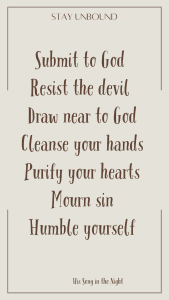
These steps are useful to fight against any sin, but since discontent is the context, let’s apply his instructions to that. We have used the last two lessons to prioritize what is important. God’s presence is much more important than what might be causing the discontentment. Yielding to God’s will rather than our own is the choice to submit to God.
Submit: to place or rank under, to subject, mid. to obey.
Resist the Devil
Resist: to take a completely contrary position to, to oppose, to ardently withstand without giving up, to refuse to be moved.
Resisting the devil first assumes that we recognize his tactics for what they are. He is using discontent to draw us away from God. When we allow the ropes of discontent to wrap back around our wrists, it gives place to the enemy to lead us back into his ways. Discontent can lead to breaking every one of God’s commandments. That is why it is so important to RESIST discontent!

What is the source of this discontent? Is it a difficult season, spouse, health diagnosis, job? Is it past regrets of choices made? Is it a hard situation that appears endless?
Emotions are real, but they are not reality. Sometimes it is necessary to ask, “Why am I feeling this way, Lord?”
Until we do, we are susceptible to the enemy’s tactics and not prepared for resistance!
Like Jesus in Matthew 4, when He withstood Satan’s temptations with, “it is written,” we must be prepared to resist his advances with God’s Word. But to resist Satan will require more than just knowing the Truth. The final “KO—knockout” also demands obedience.

K—Knowledge (John 8:32, 13:17, 2 Peter 2:2-3)
O—Obedience (1 Corinthians 10:13, James 2:18-20, 4:17)
Draw nigh to God, and he will draw nigh to you. Cleanse your hands, ye sinners; and purify your hearts, ye doubleminded.
James said the believers had prayed, but their prayers went nowhere. Why? James 4:3
Drawing near to God can be prayer, it can be opening the Bible, but it is not striving or effort or quoting Scripture that draws us near to Him. What did Jesus say in Matthew 11:28-30?
If he is meek and lowly in heart, and we are to take His yoke and learn of Him, how do we need to approach him? Demanding? Complaining? Angry? It’s not that He cannot handle our strong emotions. Of course, He can. But humility is what turns His heart toward ours every time.
The Lord is nigh unto them that are of a broken heart;
and saveth such as be of a contrite spirit. Psalm 34:18
The sacrifices of God are a broken spirit:
a broken and a contrite heart, O God, thou wilt not despise. Psalm 51:17
For thus saith the high and lofty One
that inhabiteth eternity, whose name is Holy;
I dwell in the high and holy place,
with him also that is of a contrite and humble spirit,
to revive the spirit of the humble,
and to revive the heart of the contrite ones. Isaiah 57:15
Cleansing our hands and purifying our hearts is our decision to stop acting on or thinking on sin.
Having therefore these promises, dearly beloved, let us cleanse ourselves from all filthiness of the flesh and spirit, perfecting holiness in the fear of God. 2 Corinthians 7:1
Beloved, now are we the sons of God, and it doth not yet appear what we shall be: but we know that, when he shall appear, we shall be like him; for we shall see him as he is. And every man that hath this hope in him purifieth himself, even as he is pure. 1 John 3:2-3
Why is it okay with me that I allow discontent in my heart? I must decide that it is a sin before I will ever stop allowing it. Drawing near to God requires that I agree with Him about my sin. Once that is decided in my heart, actions (clean hands) will follow suit.
Be afflicted, and mourn, and weep: let your laughter be turned to mourning, and your joy to heaviness.
Once we agree with God about our sin, we will no longer take it lightly, joke about it, or want to continue in it.
Discontentment leads to death. It kills joy. It destroys families and churches and lives. Discontent holds the enemy’s hand and believes his lying whispers that God is keeping back good things from us. It winds us back up into his cords and leaves us lying in the dust.
Jesus wants so much more for us than Satan offers in our discontent.
Next week, we are going to see the freedom and glory to God that contentment brings! For now, I want to keep those broken cords in sight while I sing with unbroken praise to the One who makes me free.
Thou tellest my wanderings:
put thou my tears into thy bottle:
are they not in thy book?
When I cry unto thee, then shall mine enemies turn back:
this I know; for God is for me.
In God will I praise his word:
in the Lord will I praise his word. Psalm 56:9-11

 His Song in the Night
♥️♥️♥️
<
div dir=”ltr”>
<
blockquote type=”cite”>
LikeLiked by 1 person